

In Conversation with
TOMAS VU
Words by Jessica Ni. Visuals by Josephine Choe.
You might know him as Tomas Vu, Tomas Daniel, or even Tomas Vu-Daniel —
Born in Da Nang in Saigon, Vietnam, by the South China Sea, Vu had never known what a war-less childhood was like. Fishing with grenades and waking up to the sound of rapid gunfire was just a typical day in his life. When he and his family followed his stepfather and immigrated to Texas following the Vietnam War, they soon realized that America was not the haven they had dreamed of. Flying into El Paso, peering out of the airplane windows and seeing acres upon acres of brown, lifeless dirt rather than the skyscrapers and cityscape Western media had spoon-fed to him, he would soon be spending years of his life trying to assimilate into this new country he now called home. However, the hardest part was not adapting to the climate nor the landscape, but rather the people.

In the 70s, many children had lost a father or a brother to the war. To them, it didn’t matter if Vu’s family was fighting alongside the Americans, whether they were fighting with the North or the South. To them, Vu and his siblings were just a vessel for their anger and frustration. Facing much more than glares and pointed fingers on the school bus, Vu and his siblings were forced to run two to three miles to school each morning with nothing but barren desert between their home and the school. To make matters worse, their lack of fluency in the English language made it difficult for them to communicate. Their stepfather had banned the usage of Vietnamese in the household in efforts to push them to learn, but there was only so much of a new language one could grasp instantly at an age where language skills are already so developed and engrained. At school, the teachers didn’t speak mimes and Vu and his siblings didn’t speak English, so drawing became their channel. Vu cites this as the main reason why he and his siblings all ended up being artists in one form or another.
No matter how much he excelled at the visual arts, whether that be his Bruce Lee action scene flipbooks or his high school drawing classes, or how many art awards he won, his mother still wanted him to learn a trade that was actually capable of making money—to her, art was just a hobby. Unsure of what he was truly passionate about, Vu went to college for Political Science, naively thinking that that could be his way of changing the world. Around that time, death squads were rampant in El Salvador and many El Salvadorians began crossing the border to enter the U.S. in hopes of seeking refuge.
Vu would often take trips to help build shanty towns and cook, and each time he went he brought his camera with him. Although his pictures of the refugees merely started as a way to document what he saw, it slowly turned into a narrative that began to pique his interest in photojournalism. He switched majors and began taking photojournalism courses at school in hopes of learning how to articulate his passion for human rights. He soon learned that those classes could never really satisfy his craving for self-expression in the way that art classes could. And hence, he embarked on his first formal training in visual arts.

Initially, Vu was embarrassed to experiment with anything tied to the Asian diaspora. He didn’t want to touch anything related to the war or anything that dealt with his identity. His painting series, Napalm Morning (1995-1999), was his first to explore his Vietnamese heritage. Both his father and his grandfather were killed by the North Vietnamese in the war, so these depictions of the napalm explosions of the Tet Offensive allowed him to pay homage to them. This series was his first attempt at looking at his past, at his identity, as a subject matter.

However, it was the surfboards that brought Vu directly back to Vietnam. He was first introduced to surfing as a child in the South China Sea by the American GIs that would go there to surf in between fighting. As a young boy he and his buddies made a business out of this, offering to carry these heavy, nine or 12 feet long boards back and forth to the beach, and charging the GIs for each trip they made. It was around this time when he had met Jerry, the GI who would befriend him—well, as much as a 13 year old boy and a young GI could be—and introduce him to The Beatles. When thinking about what narrative he wanted to pursue in his artwork, Vu realized he wanted to relocate and go back to that point in Vietnam to that moment with Jerry, listening to records. To him, this was the time before all innocence was lost.
Looking at his past projects, they all examine his past in the present, but extended to this future, end-of-man, post-human narrative as well, searching for the sign when humans will no longer be the master race and are overthrown by the machines.
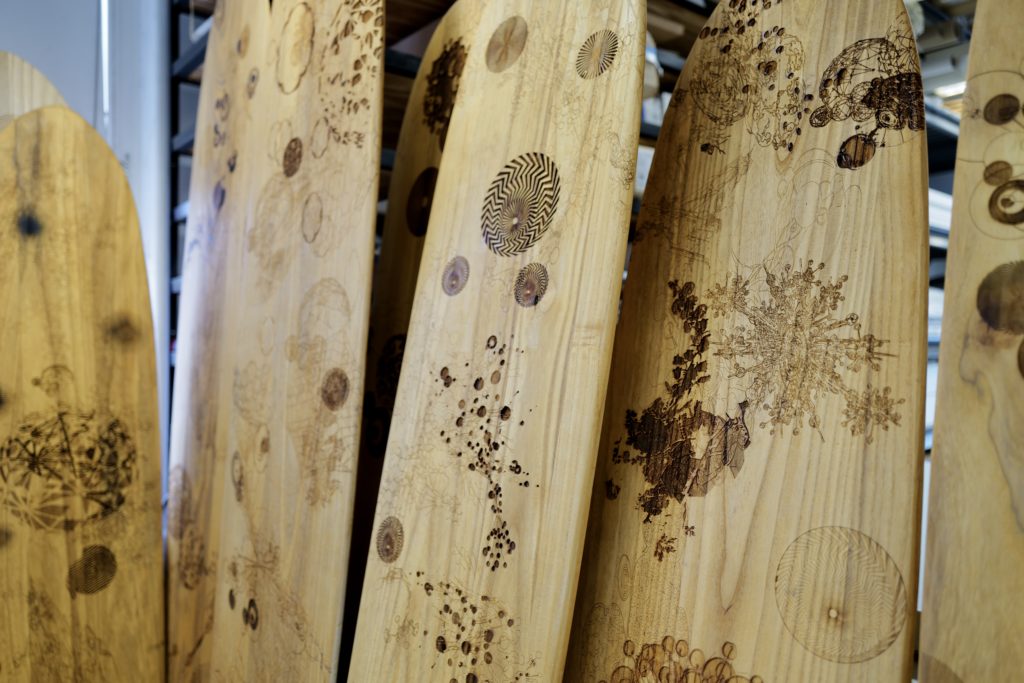
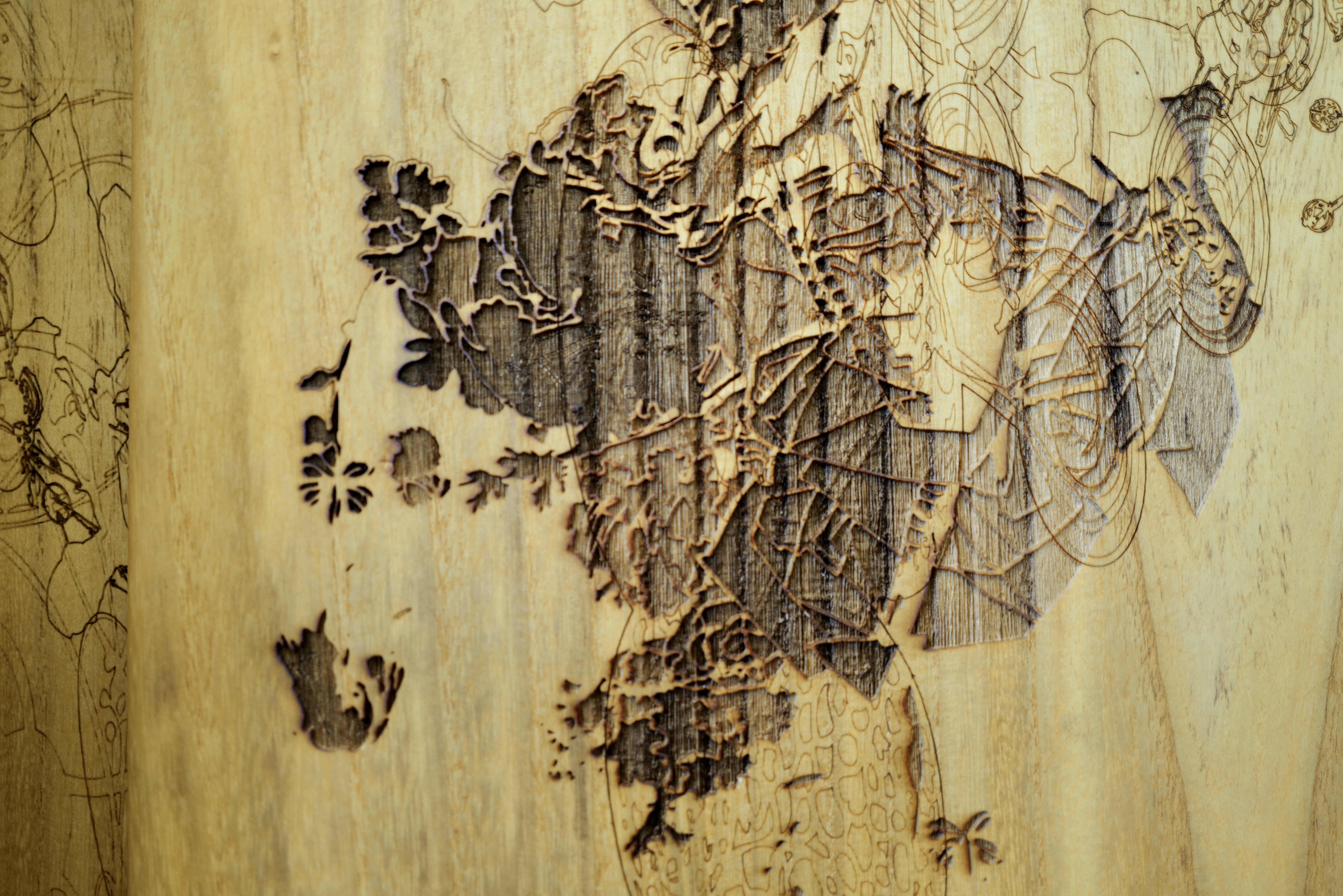
Whatever Jerry saw in Vu, this young, innocent kid, and whatever Vu saw in him, whatever that was, he wanted that connection again. Each board is hand shaped by Vu himself out of wood and coated with linseed oil. Vu’s goal is to make 210 surfboards, one for each song The Beatles released in their short eight years together–so far he has made 60. The front is the image and the back is the lyrics of the song, similar to the A-side and B-side of an album. Even though the surfboards represent a piece of his history, they also explore what the future can be, scrutinizing this idea of the man versus the machine, because as an artist he feels that it is easy to lose oneself when you don’t have that connection to the touch.
All of Vu’s work deals with the narrative of the past, the present, and the future. For him, it’s impossible to disconnect them at this point–they are all part of who he is inherently. Looking at his past projects, they all examine his past in the present, but extended to this future, end-of-man, post-human narrative as well, searching for the sign when humans will no longer be the master race and are overthrown by the machines. Greatly influenced by Ray Kurtzweil’s Singularity that he read seven years ago, Vu’s goal is to visualize things that aren’t here yet, giving his audience a glimpse into what that future looks like.
Since immigrating at 13, he has gone back to visit Vietnam three times. However, the Vietnam that he had remembered from his childhood was no longer there–the landscape had totally changed, rapidly modernizing to resemble just about any other Asian city. To this day, Vu still isn’t entirely sure if he’s been able to fully reconnect with his Vietnamese culture again and if he ever will.

Tomas Vu
@tomasstudio
tomasvu.com